


Paper on Theoretical and Applied Fracture Mechanics :: Open Access
https://doi.org/10.1016/j.tafmec.2026.105832
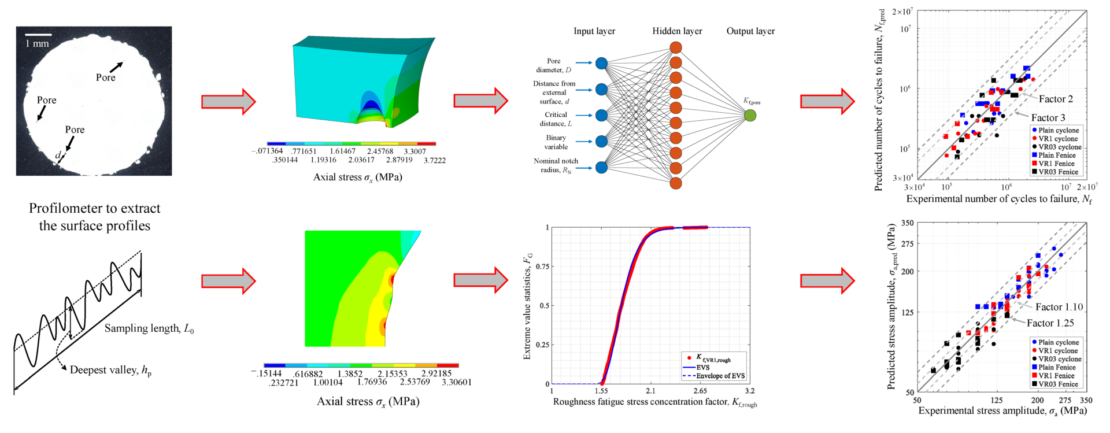
Additive manufacturing (AM) enables resource-efficient production of high-performance metallic components, but fatigue assessment remains challenging due to process-induced defects, particularly in defect-sensitive alloys such as laser powder bed fusion (LPBF) Inconel 718. This work proposes a fatigue modelling framework combining the Theory of Critical Distances (TCD), extreme value statistics (EVS), and computational surrogate models (CSMs), to quantify the effects of surface roughness, internal porosity, macro-notches, and component size on fatigue strength. The methodology was validated on plain and V-notched LPBF Inconel 718 specimens produced from two partially recycled powder feedstocks. Surface topography and porosity distributions were experimentally characterized, while FE simulations and surrogate models were used to determine fatigue stress concentration factors (FSCFs) for surface roughness and pores, respectively. The framework achieved high correlation and low symmetric mean absolute percentage error using 99th-percentile FSCFs. Numerical results agreed with fractographic observations, identifying surface roughness as the dominant crack initiation mechanism, with roughness-related FSCFs approximately 25% higher than pore-related values..
Paper on International Journal of Fatigue :: Open Access
https://doi.org/10.1016/j.ijfatigue.2025.108821
This study models the impact of surface roughness and pores on the fatigue strength of plain and V-notched Inconel 718 specimens produced via laser powder bed fusion, in both as-built and machined conditions. Fractographic analysis assessed porosity, while surface roughness was examined using an optical profilometer. Pore size and distance from the external surface were analyzed using Gumbel and exponential distribution functions. Finite element simulations of scanned surface profiles and pores were implemented, and the results were employed to calculate the fatigue stress concentration factors according to the theory of critical distances. This latter was calibrated by using the sharp and blunt V-notched specimens under machined condition. Finally, extreme value distributions were applied to estimate fatigue stress concentration factors of pores and surface roughness at 99% of probability. These latter were combined in a simplified way, and fatigue strength predictions of blunt V-notched as-built and plain machined and as-built specimens closely matched experimental data.
